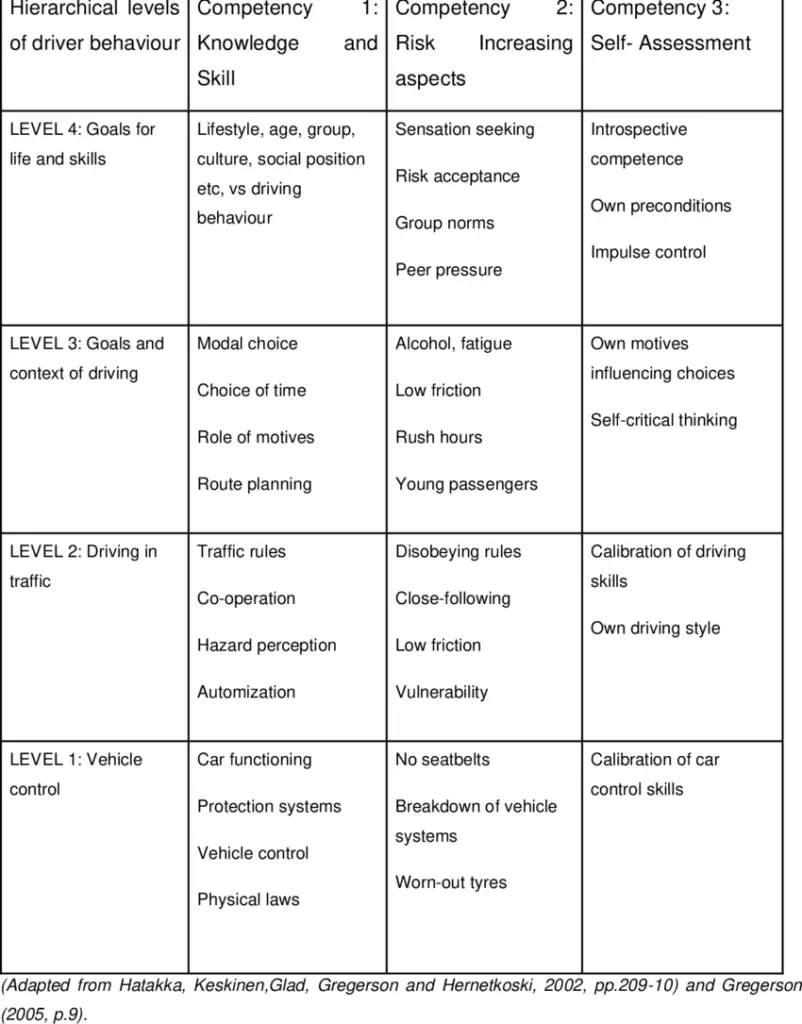
The GDE (Goals for Driver Education) Matrix is a framework that helps driving instructors understand everything a driver needs to be safe, not just the mechanics of driving.

It looks beyond teaching “how to drive the car” and digs into the bigger picture—why people drive the way they do, what influences them, and what risks they take. For ADIs, it’s a way to coach learners at a deeper level, influencing long-term safe driving rather than just passing a test.
The GDE has often been accused of being too academic and difficult to follow in its original format.
Here’s a clear, less academic breakdown you can use to teach or apply it:
The Four Levels of the GDE
Think of driving as having four levels, from the basics of operating the car up to the bigger life choices that shape our driving habits.
Level 1: Vehicle Control – The “Car Skills”

This is the foundation: steering, braking, gear changes, using controls, and performing manoeuvres.
It’s about what the hands and feet are doing.
Questions you might coach with:
“How smoothly can you control the car?”
“What helped you keep it steady on that bend?”
“How did that gear change feel to you?”
“What did you notice about your steering through the bend?”
“What helped you to move off smoothly just then on the hill?”
Level 2: The Driving Task – The “Road Skills”
This focuses on traffic rules, hazard awareness, and interacting with other road users.
It’s about scanning, observing, judging speed and distance, and keeping to the Highway Code.
 Questions to draw this out:
 “How did you decide when it was safe to go at that junction?”
“What clues did you spot that told you that car might pull out?”
“What cues told you it was safe to enter the roundabout?”
“What helped you to decide when to change lanes?”
“What hazards were you scanning for at the roundabout/junction?”
Level 3: Goals and Context of Driving – The “Journey Choices”
This is where driving links into everyday life choices.

Why did the person make that journey? How important was it? Did they need to rush?
Choices about routes, timings, taking passengers, or driving when tired all sit here.
Coaching questions might be:
“Was there a better time to make this trip?”
“How might giving a lift to friends affect your concentration?”
“Why are you choosing this route today?”
“What would you do differently if the weather changed?”
“How would you plan this journey if you were driving at night?”
Level 4: Goals for Life and Skills for Living – The “Big Picture”
This is about lifestyle, personality, and values.

A driver’s attitude to risk, peer pressure, emotional state, and confidence all shape how they act behind the wheel.
Example coaching prompts:
Why do you think some drivers speed to impress others?
How does stress, anger, or rushing change decision making?
“How does your mood affect your driving decisions?”
“What might prompt you to take more risks behind the wheel?”
“What might you do if your friends urged you to go faster?”
What kind of driver do you want to be in life—safe, responsible, considerate?
The Three Columns of the GDE
Alongside the four levels, the GDE also looks at three “columns —what drivers need at each level:
Knowledge & Skills
At each level a driver needs knowledge matched to their task.

Example: At level 1 it’s knowing how pedals work. At level 2 it’s knowledge of the rules. At level 3 it’s knowing how tiredness impacts alertness. At level 4 it’s understanding how lifestyle choices (like drinking or texting) affect driving.
Coaching prompts;
Level 1: Vehicle Control (Knowledge & Skills)
“Can you describe how the clutch works when starting off smoothly?”
“What’s the correct sequence for checking mirrors and signalling?”
“Which technique helps you maintain steady steering through a bend?”
Level 2: Driving in Traffic (Knowledge & Skills)
“What road signs or markings did you use to decide on your lane position?”
“Which skills help you safely merge onto a dual carriageway?”
“How do you decide when it’s safe to overtake?”
Level 3: Journey Goals and Context (Knowledge & Skills)
“What factors do you consider when planning your route for today’s drive?”
“How does the weather influence your approach to this journey?”
“What resources can help you check if your planned route is safe or busy?”
Level 4: Personal Attitudes and Lifelong Skills (Knowledge & Skills)
“How do your values or attitudes influence your driving decisions?”
“What personal skills help you stay calm or focused during challenging drives?”
“How might you use what you know about managing stress or fatigue to stay safe?”
Risk Awareness
It’s not enough to have the skills—you also need to recognise risk.

Example: Level one are you able to brake in time? At level 2 risk awareness means spotting hidden hazards. At level 3 it’s recognising the risk of rushing late at night. Level 4 is being able to see how your lifestyle choices could affect your driving safely.
Coaching prompts;
Level 1 Controlling the vehicle (risk)
“What could happen if you brake too harshly in this situation?”
“How would poor clutch control increase your risk, especially on a hill start?”
“What do you notice about how losing concentration might affect your speed or lane position?”
Level two traffic situations (risk)
“When joining this busy roundabout, what risks do you see and how can you manage them?”
“Which hazard did you spot first in that situation, and how did you respond?”
“How might other drivers’ mistakes create risks that affect you?”
Level three the journeys context (risk)
“What risks might be different on this journey at night rather than during the day?”
“What factors could increase the risk if you’re in a hurry or running late for work?”
“How would travelling with someone else (friend or family) change the risks you face?”
Level four self, mood lifestyle
“How do your emotions or stress levels influence the risk you take behind the wheel?”
“What could trigger you to drive less carefully, and how do you recognise those moments?”
“In what ways might your beliefs or peer pressure increase or decrease the risks you’re willing to take?”
Self-Evaluation
This is about knowing your
own limits.
Example: At level 1: “Can I stop smoothly every time?” At level 2: “Do I tend to miss cyclists?” At level 3: “Do I drive well when I’m really tired?” At level 4: “Am I overconfident in general as a driver?”

Coaching prompts
Level 1: Vehicle Control (Self-Evaluation)
“How would you rate your clutch control in that situation? What could you do differently next time?”
“What signs tell you when you’re steering smoothly? How can you check yourself?”
“How confident do you feel with your braking, and why?”
Level 2: Traffic Situations (Self-Evaluation)
“How well did you handle that roundabout? What would you improve?”
“What clues helped you notice that hazard early, and what might you look for next time?”
“How did you make your decision at that junction, and what could you do to increase your awareness?”
Level 3: Goals and Context of Driving (Self-Evaluation)
“Looking back, how well did you plan the journey? What challenges did you face?”
“What influenced your choice of route or timing today, and would you do the same again?”
“How well did you adapt your driving to changes in weather or traffic conditions?”
Level 4: Personal Goals, Lifestyle, and Skills for Life (Self-Evaluation)
“What personal habits or moods have you noticed affecting your driving choices?”
“How do your beliefs or attitudes towards risk influence your behaviour behind the wheel?”
“What can you learn about yourself from today’s drive, and what will you focus on improving in future?”
Using the GDE as an ADI
Most ADIs teach Levels 1 and 2 really well—car control and hazard management.
Coaching learners means bringing Levels 3 and 4 into lessons.
– This is where your coaching skills come to the front : you don’t just correct mistakes, you ask questions that get the learner to reflect on behaviour and as we know behaviour is the leading cause of crashes not the skill of driving.
Why This Matters for ADIs
Most crashes happen not because drivers can’t steer or brake (Level 1), but because of poor decisions, risky attitudes, and uncontrolled emotions (Levels 3 and 4).
The DVSA’s Standards Check and driving test marking system are loosely based on these broader levels.
Coaching with the GDE makes your training more reflective, helps clients self-manage risk, and prepares them to be independent long after test day.
I hope this blog has dispelled some of the myths of the GDE matrix and has made it a bit easier to understand and how to implement it in your driving lessons.
I would love to know your thoughts on this.
Woody