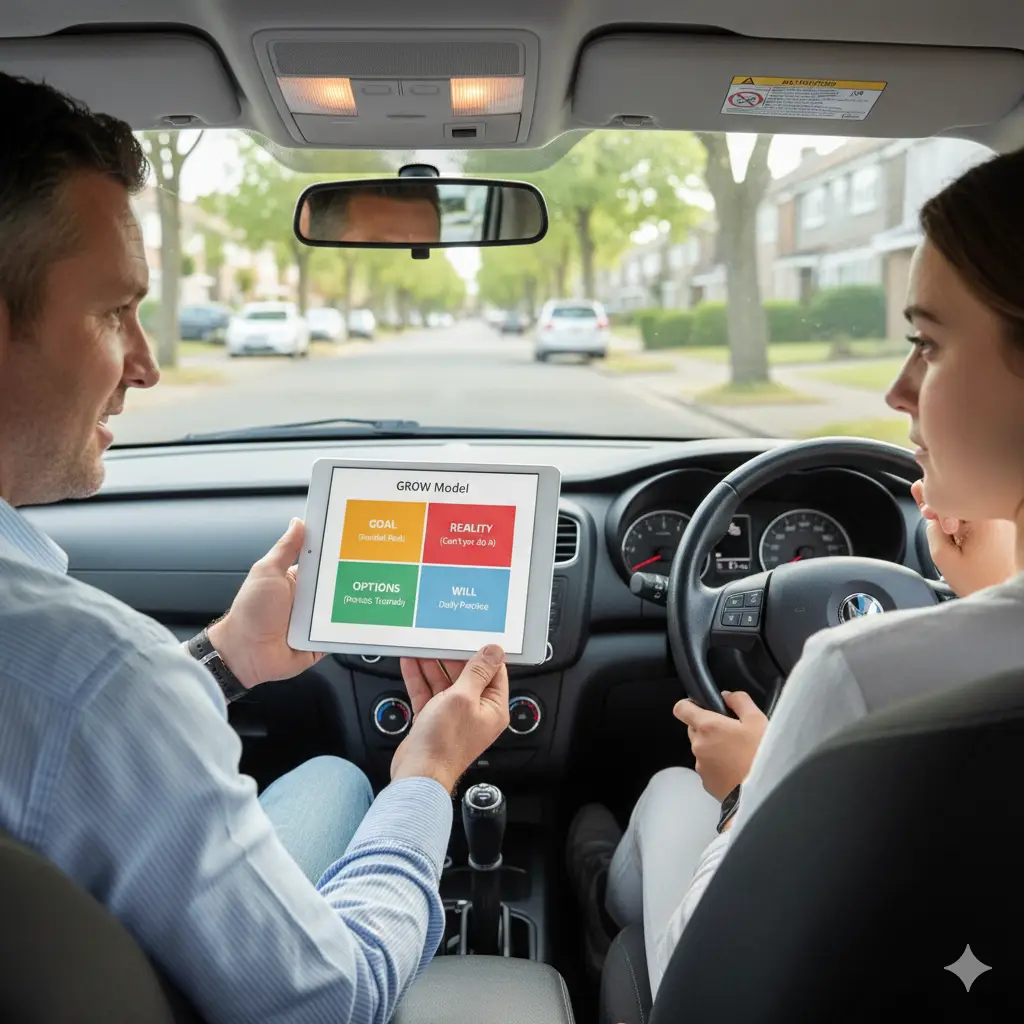
The GROW Model: History and Use in Driver Coaching
The GROW model is a widely recognized coaching framework designed to facilitate goal setting, problem solving, and performance improvement. It was popularized in the 1980s by Sir John Whitmore, along with colleagues Graham Alexander and Alan Fine. The model originated from the business and sports coaching worlds, influenced by the Inner Game method of Timothy Gallwey, which emphasizes overcoming internal obstacles to performance through reflective questioning rather than directive teaching. Whitmore’s seminal 1992 book Coaching for Performance firmly established GROW as a cornerstone of coaching practice worldwide.
GROW is an acronym representing four fundamental stages of coaching:
G – Goal: Define what the learner aims to achieve.
R – Reality: Explore the current situation and context.
O – Options: Identify alternative strategies to reach the goal.
W – Will (or Way Forward): Commit to specific action steps.
The power of GROW lies in drawing out the learner’s own insights and resources rather than prescribing solutions, thus promoting self-reliance and long-term behavioral change.
Examples of GROW in Driver Coaching
In driver coaching — whether with learner drivers or Potential Driving Instructors (PDIs) — GROW provides a structured yet flexible approach to guide learners through developmental challenges.
Goal: A learner might set a goal such as “To confidently perform independent driving on complex urban routes within six lessons.”
Reality: The coach helps the learner assess their current skills, for example, noting difficulty with lane discipline or traffic awareness.
Options: The coach and learner explore different practice strategies such as rehearsing specific junctions, using observer feedback, or simulation tools.
Will: The learner commits to specific practice tasks, like planning routes ahead and practicing at peak times to build confidence.
For a PDI working on improving lesson delivery, a goal could be “To integrate more coaching techniques into lessons to enhance learner engagement.” Reality would review current teaching styles; options might include revising lesson plans or practicing questioning techniques, and will sets measurable steps such as incorporating coaching questions in the next three lessons.
Real Driver-Coaching GROW Dialogues by Learner Level
Beginner Dialogue
Goal:
Coach: “What would you like to achieve by the end of today’s lesson?”
Learner: “I want to feel more confident with starting and stopping smoothly on quiet roads.”
Reality:
Coach: “How have you been finding starts and stops so far?”
Learner: “I sometimes stall the car or jerk when moving off, especially on hills.”
Coach: “On a scale of 1 to 10, how comfortable do you feel doing this now?”
Learner: “About a 3.”
Options:
Coach: “What could you try to improve this?”
Learner: “Maybe practice clutch control more and take it slower.”
Coach: “Any other ideas?”
Learner: “I guess I could also watch tutorial videos or practice on flat roads first.”
Will:
Coach: “Which option feels most practical right now?”
Learner: “Practicing clutch control with your guidance today sounds best.”
Coach: “Great. When will you do some extra practice outside lessons?”
Learner: “I can practice a bit in my driveway this weekend.”
Coach: “How will you know you’ve improved?”
Learner: “If I can do a smooth take off without stalling three times in a row.”
Intermediate Dialogue
Goal:
Coach: “What’s your focus for today’s lesson?”
Learner: “I want to get comfortable with roundabouts and lane discipline on busier roads.”
Reality:
Coach: “How would you describe your current experience with roundabouts?”
Learner: “I find multi-lane roundabouts confusing, especially signalling and choosing the right lane.”
Coach: “What challenges have you noticed?”
Learner: “Sometimes I hesitate or signal late.”
Options:
Coach: “What can you do to get better at roundabouts?”
Learner: “I could observe carefully before entering, plan my exit in advance, and remind myself about lane rules.”
Coach: “Anything else?”
Learner: “Maybe practicing in less busy areas before trying busy ones.”
Will:
Coach: “What will you practice during this lesson?”
Learner: “I’ll focus on planning my lanes carefully and signalling early on the roundabouts we encounter.”
Coach: “When will you review how it went?”
Learner: “After each roundabout, I’ll reflect with your feedback.”
Coach: “Sounds like a good plan.”
Advanced Dialogue
Goal:
Coach: “What skill are you aiming to improve in your advanced training?”
Learner: “I want to improve my hazard perception and anticipation in heavy traffic.”
Reality:
Coach: “How confident do you feel about anticipating hazards now?”
Learner: “I’m okay in normal traffic but tend to react late in heavy congestion.”
Coach: “What situations are hardest?”
Learner: “Sudden lane changes or brake lights far ahead.”
Options:
Coach: “What can you do to develop better anticipation?”
Learner: “I could practice scanning further ahead and use mirrors more regularly.”
Coach: “What about learning from experience?”
Learner: “Reviewing dashcam footage or discussing scenarios with you might help.”
Will:
Coach: “What will you commit to doing in the next few lessons?”
Learner: “I’ll focus on looking further ahead and consciously check mirrors every 5 seconds.”
Coach: “How will we track your progress?”
Learner: “By reviewing each lesson’s incidents and noting improvements on reaction time.”
Benefits of Goal Setting for Learners and PDIs
Goal setting enhances motivation and focus by providing clear targets for learners or PDIs to aim for. Benefits include:
Increased clarity: Helps identify what success looks like, making progress measurable.
Improved confidence: Achieving smaller goals builds momentum and self-belief.
Enhanced accountability: Structured goals encourage responsibility for learning outcomes.
Better time management: Prioritizes actions, making training sessions more effective.
Facilitated reflection: Encourages learners and instructors to review performance and identify areas for improvement.
This clarity and structure can reduce anxiety around driving tasks, enabling learners to develop safer, more competent driving behaviour’s.
What is a SMART Goal
In coaching and driver training, SMART goals are used to make objectives clear and actionable. SMART is an acronym for:
Specific: The goal is precise and well-defined. (“Practice parallel parking on the left-hand side of the road in five lessons.”)
Measurable: Progress can be tracked quantitatively or qualitatively. (“Successfully park without assistance three times in a row.”)
Achievable: The goal is realistic, given the learner’s current skills and timeframe. (“Practice parking in a quiet residential area before moving to busier streets.”)
Relevant: The goal aligns with overall learning or driving competencies. (“Improves parking skill necessary for the driving test.”)
Time-bound: The goal has a clear deadline or timeframe. (“Master this skill within two weeks.”)
Using SMART goals within the GROW framework helps learners and PDIs stay focused on meaningful actions with clear expectations and deadlines. It also helps coaches tailor interventions and assess effectiveness.
Woody

Yo, anyone tried 88online66? I’ve been browsing around and their site looks pretty slick. Thinking of throwing a few bucks their way. If you give it a whirl let me know your thoughts! Find out more: 88online66.
Glassicasino is pretty slick. The design is clean and modern, and I appreciate that. Game selection’s solid, and the bonus offers seem legit. Aesthetics are on point! For a classy casino experience check out glassicasino.
If you’re looking for a new online casino to try, Khelostarcasino is worth a look. Decent selection of games and the site seems pretty legit. Do your research, but I’ve had a positive experience so far. See more: khelostarcasino
Alright, folks, just checked out lotus365interface. Seems legit, easy to navigate, and got what I needed quick. Give it a shot if you’re looking for this kinda thing. What’s not to like, eh? Check it out here: lotus365interface
Heard about BHTClubWebsite from a mate. Gave it a go and gotta say, not bad at all! Easy to use and the games are pretty fun. Definitely worth checking out if you’re looking for something new. bhtclubwebsite
Right, going straight to the JalwaOfficialWebsite to see what the official buzz is all about! Always best to go to the source! Hoping for a good experience. jalwaofficialwebsite
Citibet88bet, huh? Sounds kinda catchy. I’m always on the lookout for a new place to play. Anyone got any firsthand experience with ’em? Let me know if it’s worth a punt! Find it here: citibet88bet
Checked out mex52bet. Some solid stuff there, if you’re looking for a place to place some bets. Might give it another try! Give it a look: mex52bet
2727bet delivers what it promises. Betting options are solid, nothing too crazy but dependable. Worth a try for the dedicated bettor 2727bet.
Alright, vnxin88, let me tell you. Was kinda skeptical at first, but pleasantly surprised. Decent selection and haven’t had any issues. Give it a shot, you might dig it! vnxin88
Okbajee24 is my new go-to! Super easy to navigate and some cool bonuses. Definitely worth a look see! Hit it up here: okbajee24